

You can memorize every relationship tip and communication technique out there, but without understanding your own emotions, and those of the people around you, lasting connection remains out of reach. That’s where the emotional intelligence definition comes into focus: it’s the foundation that determines how well you navigate conflicts, read your partner’s unspoken needs, and respond under pressure.
At Clear Life Happiness, we’ve seen how emotional intelligence separates couples who thrive from those who struggle. It’s not about being overly sensitive or suppressing feelings. It’s a learnable set of skills that directly impacts your relationships, career, and overall well-being.
You may be interested


This article breaks down what emotional intelligence actually means, the core components that make it work, and real examples of how these skills show up in everyday life. Whether you’re working on yourself or trying to understand someone you love, this is where meaningful change begins.
What emotional intelligence means
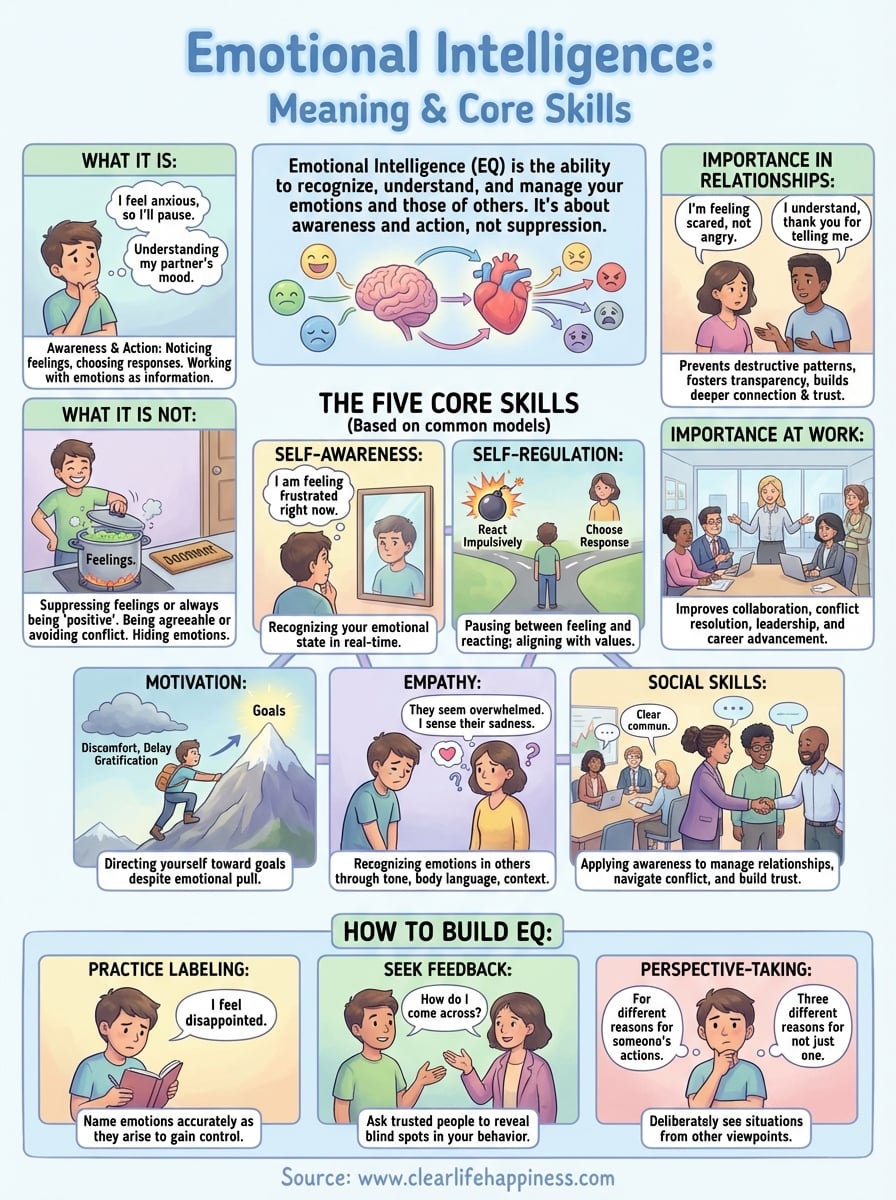
Emotional intelligence (often called EQ) is your ability to recognize, understand, and manage emotions, both your own and those of others. Unlike IQ, which measures cognitive ability, emotional intelligence measures how well you navigate the human side of life. You use it every time you pause before reacting in anger, pick up on your partner’s mood without them saying a word, or adjust your approach based on how someone responds to you.
The emotional intelligence definition centers on awareness and action. You first notice what you’re feeling and why. Then you decide how to respond in a way that serves your goals and relationships. This isn’t about suppressing emotions or always being positive. It’s about working with your emotions as information rather than letting them control your behavior.
The practical meaning in everyday life
When you have strong emotional intelligence, you catch yourself mid-spiral before anxiety takes over or anger destroys a conversation. You notice the tightness in your chest during a disagreement and recognize it as fear of abandonment, not just irritation at dirty dishes. This awareness gives you choice. Instead of defaulting to defensive sarcasm or shutting down completely, you can say, “I’m feeling scared right now and need reassurance,” which changes everything.
You also read other people more accurately. Your colleague’s short emails aren’t necessarily rude. Your partner’s quiet mood after work isn’t about you. Emotional intelligence helps you separate your assumptions from reality. You ask questions instead of jumping to conclusions. You adjust your tone when you sense someone is overwhelmed. These small shifts prevent most conflicts before they start and deepen trust in every relationship you have.
Emotional intelligence isn’t mind reading. It’s pattern recognition combined with the humility to check your interpretations.
What emotional intelligence is not
Emotional intelligence doesn’t mean you’re always calm or that you never get angry, hurt, or frustrated. People often confuse EQ with emotional suppression, but hiding feelings is the opposite of emotional intelligence. You need to feel your emotions fully to understand them. The difference is that you choose when and how to express them rather than letting them explode or fester.
It’s also not about being agreeable or avoiding conflict. High EQ actually requires you to have difficult conversations because you understand that unaddressed resentment damages relationships more than honest disagreement. You know when to push back, when to compromise, and when to walk away. Emotional intelligence gives you the courage to be direct while remaining kind, which is far more valuable than keeping the peace at all costs.
Core skills and the main models
The emotional intelligence definition gets clearer when you understand its specific components. Researchers have proposed different models, but they all center on similar skills: recognizing emotions, understanding what they mean, managing your responses, and applying this awareness to relationships. These aren’t vague personality traits. They’re concrete abilities you can observe, measure, and improve through practice.
The five core skills
Self-awareness forms the foundation. You notice your emotional state as it happens, not hours later when you’re replaying the conversation. Self-regulation follows close behind: you pause between feeling and reacting, choosing responses that align with your values rather than your impulses. Motivation means you can direct yourself toward goals even when emotions pull you elsewhere. You push through discomfort, delay gratification, and maintain focus when frustration mounts.
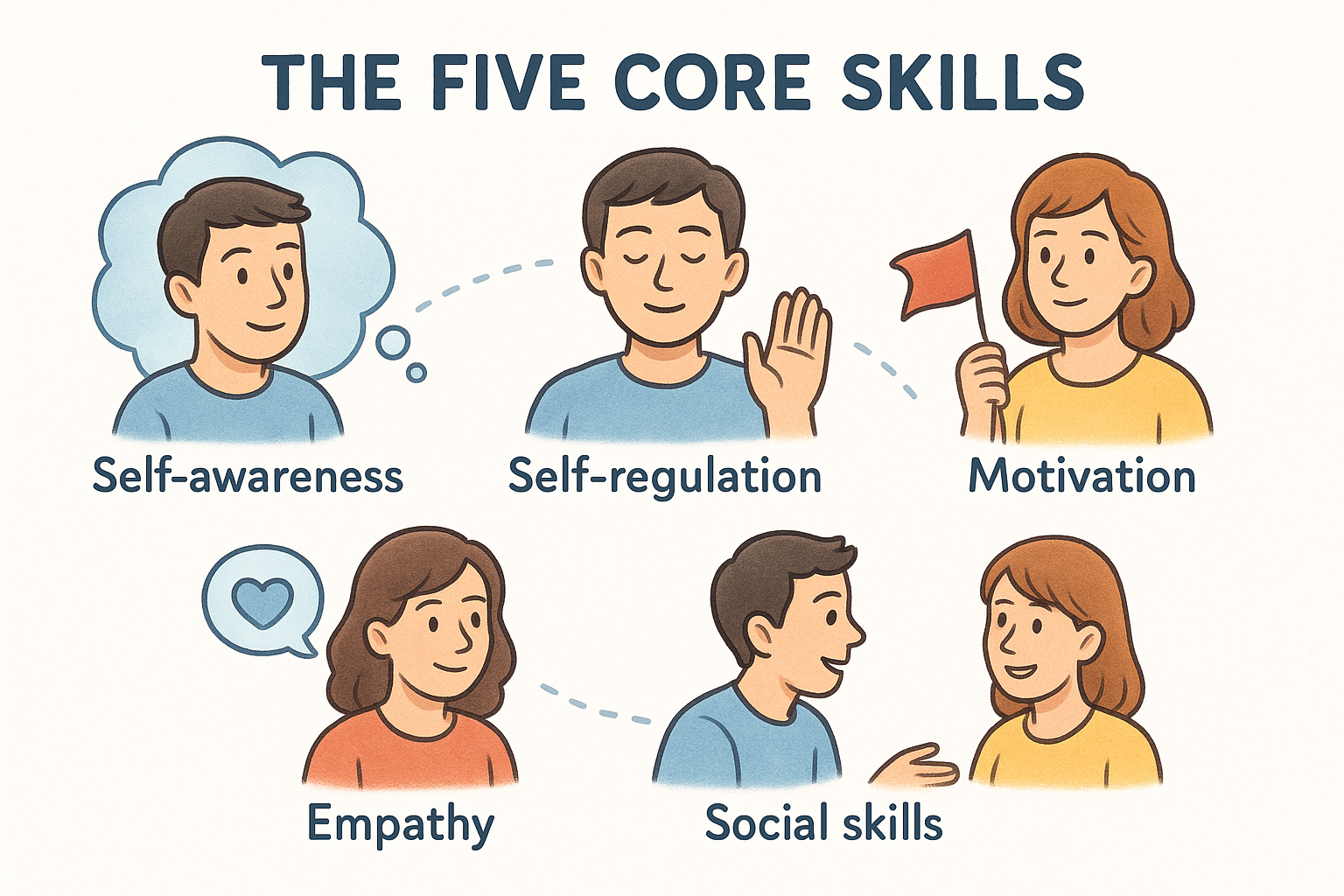
Empathy extends these skills outward. You recognize emotions in others through tone, body language, and context. Social skills complete the framework by applying everything you’ve learned to real interactions. You navigate conflicts, inspire trust, and adjust your communication style based on who you’re talking to and what they need in that moment.
Emotional intelligence isn’t one skill. It’s a system where each component reinforces the others.
How the models differ
Daniel Goleman popularized the five-component model described above, which emphasizes practical application in leadership and workplace settings. His framework focuses on how emotional intelligence drives performance and relationship quality. The Mayer-Salovey model takes a different approach, organizing EQ into four branches: perceiving emotions accurately, using emotions to facilitate thinking, understanding emotional patterns and transitions, and managing emotions in yourself and others. This model treats emotional intelligence as a specific type of intelligence rather than a mix of personality traits and abilities.
Both models agree on the fundamentals. You need to know what you’re feeling, understand why you’re feeling it, and manage those feelings effectively while doing the same for others. The difference lies mainly in how researchers categorize and measure these skills, not in what actually matters for your relationships and daily life.
Why emotional intelligence matters in relationships
Your emotional intelligence directly determines the quality of your intimate relationships. When you understand what you’re feeling and can communicate it clearly, your partner doesn’t have to guess what’s wrong or decode passive-aggressive signals. This transparency builds trust faster than any other relationship skill because it eliminates the exhausting guessing games that erode connection over time.
How emotional intelligence prevents destructive patterns
Low emotional intelligence creates predictable relationship disasters. You misread your partner’s stress as rejection, then withdraw or attack, which makes them actually pull away, confirming your initial fear. This cycle repeats until both people feel misunderstood and alone despite sharing a bed every night. Without the ability to identify your emotions accurately, you’ll project old wounds onto new relationships and sabotage connection before it has a chance to deepen.

Partners with strong emotional intelligence catch these spirals early. They notice when their anxiety is driving interpretation rather than responding to actual behavior. They ask questions instead of making accusations. When your partner snaps at you, high EQ helps you recognize their tone as overwhelm, not contempt, which changes your entire response from defensive to supportive.
The emotional intelligence definition matters most when conflict hits. That’s when your EQ either saves the relationship or damages it beyond repair.
Building deeper connection through emotional awareness
Emotional intelligence transforms surface-level relationships into genuine intimacy. You share what you actually feel, not just facts about your day. Your partner does the same because you’ve created safety through your non-reactive presence. This vulnerability compounds over time, building the kind of bond that survives hardship instead of crumbling at the first real test.
You also meet your partner’s needs more accurately when you understand emotions as information. Their silence after work isn’t mysterious or frustrating. You recognize it as their processing mode and give space instead of demanding engagement, which is exactly what they needed without having to explain it.
Why emotional intelligence matters at work
Your technical skills get you hired, but emotional intelligence determines how far you advance. Workplaces run on collaboration, and collaboration depends on reading rooms, managing stress under deadlines, and navigating personality conflicts without creating enemies. Every promotion, difficult project, and high-stakes negotiation tests your EQ more than your ability to execute tasks. The colleague with average technical ability but strong emotional intelligence consistently outperforms the brilliant person who alienates their team.
How emotional intelligence shapes workplace dynamics
You work faster and better when emotional intelligence is high across your team because people communicate clearly instead of dancing around issues. Feedback becomes productive rather than defensive. Conflicts get resolved quickly because everyone involved can separate their ego from the problem and focus on solutions. Your stress level drops significantly when you’re surrounded by colleagues who manage their emotions well, which directly impacts your productivity and job satisfaction.
Poor emotional intelligence creates toxic work environments where small disagreements escalate into long-term grudges. One person’s inability to regulate their frustration infects the entire team’s morale. You waste hours managing interpersonal drama instead of doing actual work, and talented people leave for companies where they don’t have to walk on eggshells around emotionally volatile colleagues.
Understanding the emotional intelligence definition matters just as much in conference rooms as it does in your living room.
Why leaders need exceptional emotional intelligence
Management requires you to motivate people, resolve conflicts, and make decisions that affect others’ livelihoods, all of which demand high EQ. Leaders with strong emotional intelligence inspire loyalty because their teams feel seen, heard, and valued even during difficult transitions. They deliver criticism without destroying confidence and push for results without burning people out. This balance between compassion and accountability only comes from understanding emotions as strategic information rather than inconvenient distractions.
Companies increasingly screen for emotional intelligence during hiring and promotion decisions because they’ve learned that technical expertise without EQ creates more problems than it solves. Your career ceiling is often determined by your ability to handle pressure, read stakeholders, and build relationships across different personality types, not by how many certifications you collect.
How to build emotional intelligence skills
Building emotional intelligence requires consistent practice, not sudden transformation. You develop these skills through intentional daily actions that strengthen your awareness and response patterns over time. The emotional intelligence definition describes abilities you already possess to some degree, and your goal is to refine them through deliberate attention rather than waiting for natural improvement that may never come.
Practice emotional labeling throughout your day
Start by naming your emotions accurately as they arise. Instead of defaulting to “good” or “bad,” get specific: frustrated, disappointed, anxious, excited, overwhelmed, or relieved. This precision trains your brain to recognize subtle differences between similar feelings, which gives you more control over your responses. When you notice tension in your shoulders during a meeting, pause internally and ask what emotion created that physical response. Write down your observations if it helps cement the pattern recognition.
Your accuracy improves dramatically with repetition. You begin catching emotions earlier in their development, sometimes before they fully form into reactions. This early detection is where real change happens because you can redirect your energy before it turns into defensiveness or withdrawal. The simple act of labeling reduces emotional intensity by engaging your logical brain, which creates the space you need to choose your next move consciously.
Building emotional intelligence isn’t about feeling different emotions. It’s about recognizing them faster and responding more deliberately.
Seek feedback and practice perspective-taking
Ask trusted people how you come across during difficult conversations or stressful moments. Their observations reveal blind spots you can’t see from inside your own experience. You might think you’re staying calm when your tone actually sounds dismissive, or believe you’re being clear when you’re actually being vague. This external input accelerates your development faster than self-reflection alone ever could.
Practice seeing situations from other viewpoints deliberately. When someone frustrates you, force yourself to list three possible explanations for their behavior that have nothing to do with you. This exercise breaks your default assumption that everything relates to your relationship with them and builds the empathy muscle that transforms how you navigate conflicts.
Next steps
Understanding the emotional intelligence definition is only the beginning. Your real growth happens when you apply these skills consistently in your daily interactions, relationships, and work environments. The awareness you’ve gained here means nothing without practice, and practice means accepting that you’ll stumble, misread situations, and react poorly sometimes. That’s part of the learning process, not a sign of failure.
Start small today. Notice one emotion accurately. Pause before reacting once. Ask for clarification instead of assuming. These micro-actions compound into significant relationship transformation over weeks and months. Every relationship in your life improves when you understand both your emotions and those of the people around you. The changes start immediately once you commit to awareness, and the momentum builds from there.
Ready to strengthen your relationships even further? Explore more proven strategies for building deeper connections and lasting happiness that work in the real world, not just in theory.

