

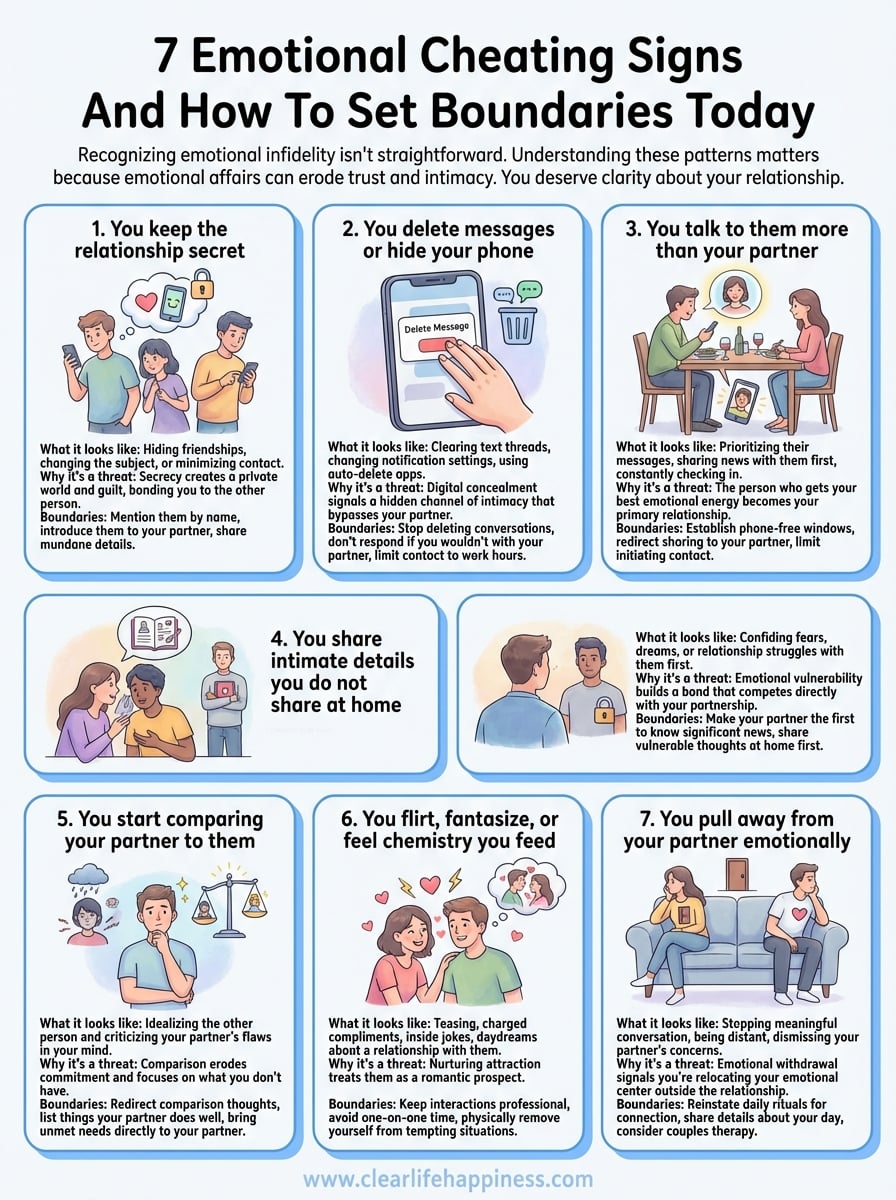
Something feels off in your relationship, but you can’t quite name it. There’s no lipstick on the collar or suspicious hotel receipts, just a growing distance that makes your stomach turn. Recognizing emotional cheating signs isn’t always straightforward, and that uncertainty can feel isolating. The line between a close friendship and an emotional affair often blurs in ways that leave partners questioning their own instincts.
Emotional infidelity doesn’t announce itself with obvious red flags. It creeps in through late-night texts, inside jokes that exclude you, and a partner who suddenly shares more with someone else than with you. Understanding these patterns matters because emotional affairs can erode trust and intimacy just as deeply as physical ones. You deserve clarity about what’s actually happening in your relationship.
You may be interested


At Clear Life Happiness, we focus on giving you the tools to build stronger, more honest connections with your partner. This guide breaks down seven specific signs that may indicate emotional cheating, plus practical steps for setting boundaries that protect your partnership. Whether you’re trying to examine your own behavior or evaluate your partner’s actions, these insights will help you move forward with confidence and a clearer understanding of where healthy friendships end and emotional infidelity begins.
1. You keep the relationship secret
Secrecy marks one of the clearest emotional cheating signs because it reveals an awareness that something isn’t quite right. When you actively hide a friendship or connection from your partner, you’re creating a separate emotional world that excludes them. This deliberate concealment transforms an innocent relationship into something that threatens the foundation of trust you’ve built together.
What this sign looks like in real life
You mention your new coworker only in passing, never by name, even though you’ve grabbed lunch together three times this week. Your partner asks who texted you, and you say “just a friend from work” without offering their name or what you discussed. You change the subject quickly when conversations drift toward this person, or you minimize how often you actually talk.
Maybe you’ve started meeting this person for coffee but frame it as “running errands” when your partner asks about your afternoon. The omissions pile up until you realize you’re carefully editing stories to remove any mention of someone who’s become a significant part of your day. These small lies of omission signal that you already sense you’re crossing a line, even if nothing physical has happened.
Why secrecy changes a friendship into a threat
Healthy friendships don’t require hiding because they operate within boundaries that respect your primary relationship. When you start concealing interactions, you’re acknowledging that your partner would feel uncomfortable or hurt if they knew the full truth. This awareness creates guilt, which often leads to more secrecy in a self-perpetuating cycle.
Secrecy doesn’t just hide a relationship; it actively feeds the emotional intimacy by creating a private world that feels special precisely because it’s shared only between the two of you.
The act of keeping secrets bonds you to the other person in ways that compete directly with your commitment to your partner. You’re investing emotional energy into protecting this connection rather than strengthening your primary relationship.
Boundaries to set today to rebuild transparency
Start mentioning this person by name in casual conversation with your partner, including details about your interactions that feel mundane but honest. If you grab coffee together, tell your partner beforehand or mention it naturally afterward without waiting to be asked. This transparency removes the power that secrecy holds over you.
Introduce the person to your partner when the opportunity arises, whether that’s at a work event or by suggesting the three of you meet for a casual meal. Making your relationships visible to each other eliminates the hidden compartment where emotional affairs grow. You should also consider whether any one-on-one time needs to shift to group settings if the friendship has become too emotionally charged.
What to say to your partner without escalating
Approach the conversation with ownership rather than defensiveness. You might say, “I realized I haven’t been totally open about my friendship with [name], and I want to change that. We’ve been talking more than I’ve mentioned, and I should have told you sooner.” This acknowledges the problem without making excuses.
If your partner expresses hurt or concern, resist the urge to minimize their feelings by insisting nothing happened. Instead, try: “You’re right that I should have been more transparent. I want to rebuild that trust, and I’m willing to set whatever boundaries you need to feel secure again.” This response validates their reaction while committing to concrete change that protects your relationship moving forward.
2. You delete messages or hide your phone
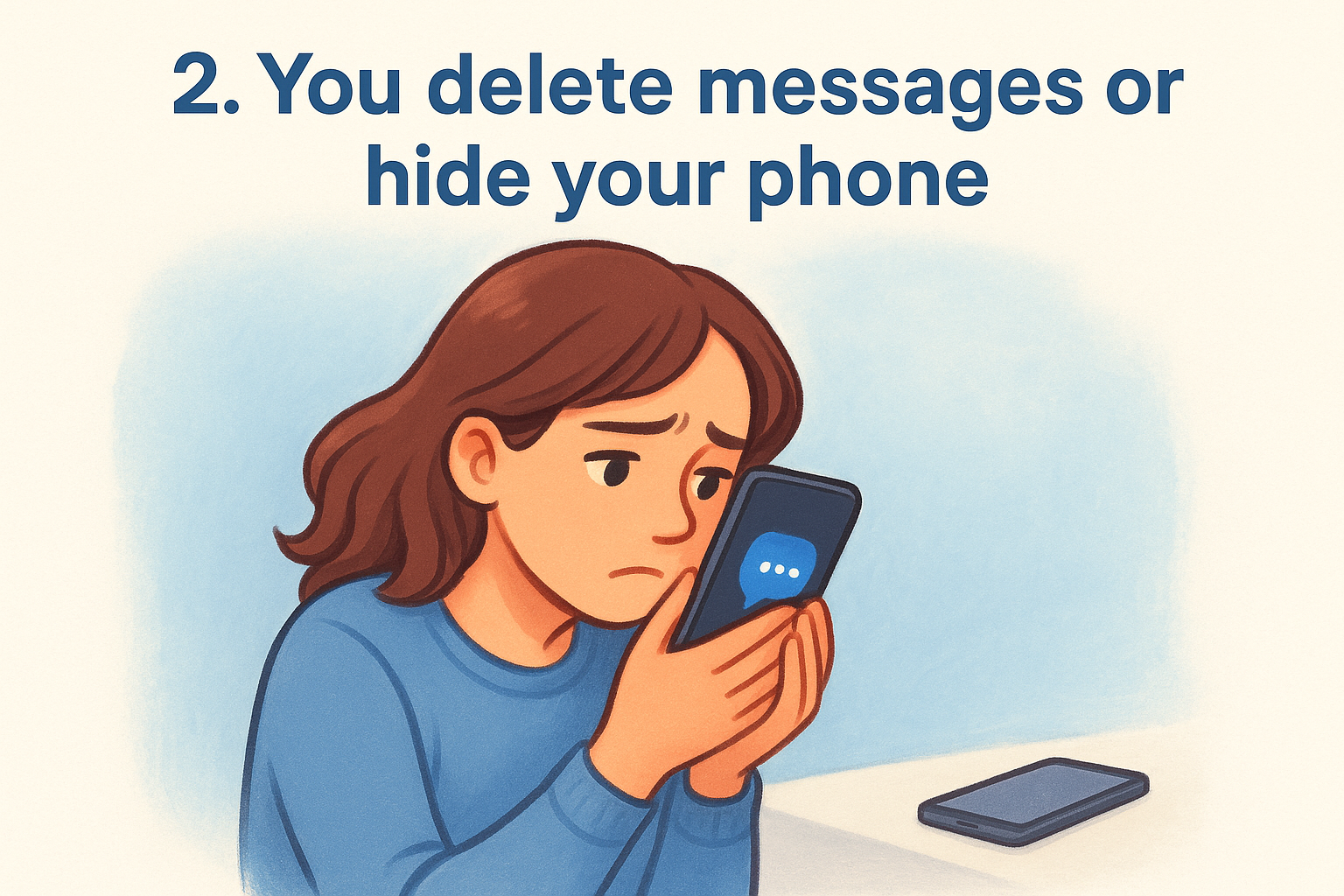
Your phone habits reveal emotional boundaries better than your words ever will. When you find yourself clearing text threads before your partner walks by or angling your screen away during conversations, you’re protecting something that shouldn’t need protection. This digital concealment represents one of the most common emotional cheating signs because it creates a hidden channel of intimacy that bypasses your primary relationship entirely.
What this sign looks like in real life
You wait until you’re alone to respond to certain messages, even though you used to text freely in front of your partner. Your notification settings change so specific contacts don’t display previews on your lock screen. You’ve started using apps that automatically delete messages after they’re read, justifying it as “keeping things tidy” when really you’re erasing evidence of emotional intimacy that would upset your partner if discovered.
Why digital hiding counts even without physical cheating
The secrecy itself damages trust more than the content of the messages. Your partner doesn’t need to read every text, but they should feel confident that nothing happening on your phone threatens your relationship. Hiding digital communication signals that you’ve created an emotional space where your partner isn’t welcome, which fractures the openness that healthy partnerships require.
The moment you start deleting messages out of fear rather than privacy is the moment a friendship has crossed into emotional infidelity.
Boundaries to set today for texting, DMs, and calls
Stop deleting conversations with this person and let them exist naturally in your message history. Set a personal rule that you won’t respond to certain messages when you’re alone if you wouldn’t feel comfortable responding with your partner nearby. Consider limiting contact to work hours only or switching communication to group chats that include others, which naturally reduces the intensity of one-on-one exchanges.
How to handle privacy vs secrecy in a healthy way
Privacy means having space for your own thoughts and friendships without constant monitoring, while secrecy involves deliberately hiding information that affects your relationship. You don’t need to share every casual conversation, but you should never feel the need to conceal who you’re talking to or the general nature of your exchanges. Healthy privacy allows your partner to pick up your phone without you panicking about what they might see.
3. You talk to them more than your partner
Communication frequency becomes one of the most telling emotional cheating signs when someone outside your relationship receives more of your thoughts, time, and energy than your partner does. This shift doesn’t happen overnight, but once you notice yourself reaching for your phone to text them before sharing news with the person you’re committed to, you’ve redirected your emotional investment in ways that undermine your primary bond.
What this sign looks like in real life
Your partner mentions their tough day at work, and you offer a quick “that’s rough” before returning to your phone to continue a conversation with someone else. You find yourself waiting for this other person’s messages more eagerly than you anticipate talking with your partner in the evening. During your commute, lunch break, and before bed, you’re checking in with them instead of your partner, creating a constant thread of connection that replaces the intimacy you used to share at home.
Why emotional priority creates a second relationship
The person who occupies most of your mental and emotional bandwidth becomes your primary relationship, regardless of labels or official status. When you consistently choose to share your day with someone else first, you’re building intimacy through accumulation of small moments that should strengthen your committed partnership instead.
Emotional affairs thrive on the daily micro-connections that transform a casual friendship into the person you most want to talk to.
Boundaries to set today for time, attention, and availability
Establish communication windows where you’re fully present with your partner without checking messages from others. Set a personal limit on how many times per day you initiate contact with this person, and redirect that energy toward your partner by sending them the random thoughts or funny observations you’d normally share with someone else. Stop responding immediately to every message from this person, creating space where your partner naturally fills that emotional role again.
How to reconnect with your partner using small daily habits
Ask your partner three specific questions about their day rather than offering generic check-ins, which forces you to listen actively and engage meaningfully. Share something from your day before you’ve told anyone else, rebuilding the pattern of your partner being your first call. Schedule fifteen minutes of phone-free conversation each evening where you both put devices away completely, allowing natural connection to rebuild without competing for your attention against outside relationships.
4. You share intimate details you do not share at home
Emotional intimacy grows through vulnerability, and when you consistently choose to reveal your fears, dreams, or struggles to someone outside your relationship, you’re building a bond that competes directly with your partnership. This pattern represents one of the more subtle emotional cheating signs because it feels natural to confide in a friend, yet it becomes damaging when that friend knows more about your inner world than your partner does.
What this sign looks like in real life
You tell this person about your anxiety over an upcoming project but never mention it to your partner. They know about your complicated relationship with your parents while your partner only gets surface-level updates. You’ve shared your career doubts, body insecurities, or childhood memories with them in detail, creating a depth of understanding that should belong to your committed relationship. Your partner asks how you’re doing, and you say “fine” while texting this other person paragraphs about what’s actually weighing on you.
Why emotional vulnerability can become emotional intimacy
Vulnerability creates connection faster than almost any other interaction, which is why it feels so powerful when someone truly sees and understands you. When you reserve your deepest thoughts for someone else, you’re essentially conducting the emotional work of a relationship outside your partnership, leaving your actual partner on the periphery of your life rather than at its center.
Emotional intimacy doesn’t require physical touch to betray a relationship; it just requires giving someone else the vulnerable parts of yourself that your partner should receive first.
Boundaries to set today for what you share outside the relationship
Make your partner the first person you tell when something significant happens in your emotional landscape, good or bad. Set a personal guideline that anything requiring real vulnerability should go to your partner before anyone else, whether that’s fears about your career, conflicts with family, or feelings about your self-worth. You can still have close friendships, but they should complement rather than replace the intimacy you share at home.
How to repair trust after oversharing
Start by acknowledging what you’ve withheld from your partner without making them feel they failed to create space for you. Try saying, “I’ve been sharing things with [name] that I should have brought to you first, and I want to change that pattern.” Then actively practice bringing those conversations home by initiating vulnerable discussions with your partner, which rebuilds the emotional pipeline that’s been redirected elsewhere.
5. You start comparing your partner to them
Comparison becomes one of the most destructive emotional cheating signs because it positions someone outside your relationship as a standard your partner can never meet. When you find yourself thinking “they would never react that way” or “they actually listen when I talk,” you’re building a fantasy version of this person while cataloging every perceived flaw in your partner. This mental scorekeeping erodes your commitment by making your current relationship feel inadequate rather than focusing on what you can build together.
What this sign looks like in real life
You notice your partner’s communication style and think about how this other person would handle the conversation differently. Their sense of humor seems sharper, their interests more aligned with yours, or their ambition more impressive than what you see at home. You’ve started mentally noting ways your partner disappoints you compared to this idealized alternative, whether that’s how they dress, how they handle stress, or how often they initiate affection.
Why idealizing the other person damages commitment
You’re comparing your partner’s complete reality against carefully curated moments with someone who doesn’t share your bills, grocery shopping, or stressful mornings. This person seems perfect because you only see their highlight reel while your partner gets judged for every mundane struggle of daily life.
The grass looks greener in an emotional affair because you’re only watering that lawn with attention and imagination, not the hard work of real partnership.
Boundaries to set today to stop the comparison loop
Actively redirect comparison thoughts by listing three things your partner does well whenever you catch yourself making unfavorable assessments. Stop discussing your relationship frustrations with this person entirely, which only reinforces the comparison pattern and gives them ammunition to position themselves as better. Reduce contact with this person if you can’t interact without measuring your partner against them.
How to bring unmet needs to your partner directly
Tell your partner what you need using specific requests rather than vague complaints that stem from comparing them to someone else. Instead of “you never listen,” try “I’d really appreciate it if we could spend fifteen minutes talking about my day without distractions.” This approach creates opportunities for your partner to meet your needs rather than failing against an invisible standard they don’t know exists.
6. You flirt, fantasize, or feel chemistry you feed
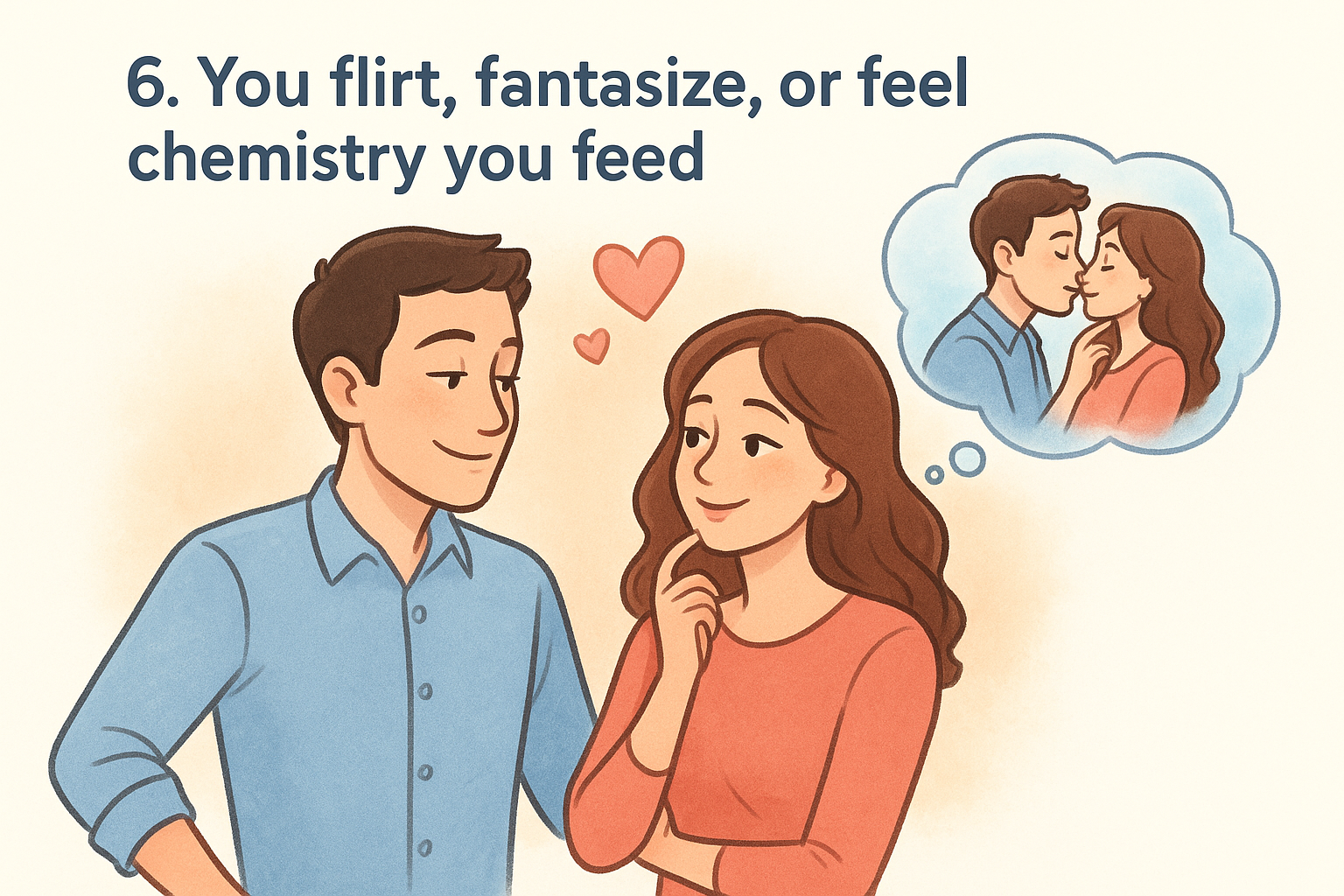
Physical attraction doesn’t equal betrayal, but choosing to nurture that spark by flirting, lingering in fantasies, or engineering opportunities to be alone together transforms natural chemistry into one of the clearest emotional cheating signs. When you actively feed attraction rather than creating distance from it, you’re treating this person as a romantic prospect instead of respecting the commitment you’ve made to your partner.
What this sign looks like in real life
You catch yourself dressing differently on days you know you’ll see this person. Your conversations include teasing that feels charged, compliments that go beyond friendly, or inside jokes that create an “us against the world” dynamic. You’ve started imagining what a relationship with them would be like, playing out scenarios in your head where you’re together instead of with your partner. These daydreams feel exciting rather than wrong, which signals you’ve already emotionally invested in the possibility.
Why attraction is normal but nurturing it crosses the line
Feeling attracted to people outside your relationship is a human experience that doesn’t automatically threaten your partnership. What matters is how you respond to that attraction. When you lean into the chemistry by seeking out this person’s company, responding enthusiastically to their flirtation, or allowing yourself to fantasize about them, you’re cultivating feelings that compete with your commitment rather than letting a passing attraction fade naturally.
Attraction becomes emotional infidelity the moment you start feeding it instead of starving it of the attention it needs to grow.
Boundaries to set today around flirting and one-on-one time
Stop complimenting this person in ways that could be interpreted as romantic interest, keeping interactions strictly professional or casually friendly. Eliminate one-on-one time that isn’t absolutely necessary, opting for group settings or public spaces where the dynamic stays appropriate. When you feel yourself wanting to flirt or test the chemistry between you, physically remove yourself from the situation by ending the conversation or finding a reason to include others.
How to reduce temptation in work and social settings
Change your routine to minimize contact with this person if you work together, whether that means taking lunch at different times or requesting project reassignments if possible. In social settings, position yourself near your partner or other friends rather than gravitating toward this person naturally. Redirect conversations that start feeling too personal by keeping responses brief and steering toward topics that include others rather than creating intimate exchanges.
7. You pull away from your partner emotionally
Emotional withdrawal often serves as the final confirmation that something has shifted in your relationship, making it one of the most serious emotional cheating signs to recognize. When you stop sharing your inner world with your partner while simultaneously opening up to someone else, you’ve essentially relocated the emotional center of your life outside your committed relationship. This distance doesn’t always feel dramatic, but it creates a growing gap that becomes harder to bridge the longer it continues.
What this sign looks like in real life
You’ve stopped initiating conversations about meaningful topics with your partner, offering only surface-level responses when they ask how you’re doing. Physical presence doesn’t equal emotional availability, and you find yourself going through the motions of your relationship while keeping your real thoughts and feelings locked away. Your partner notices you seem distracted or distant, but you dismiss their concerns rather than acknowledging the emotional space that’s opened between you.
Why emotional distance is often the biggest red flag
Withdrawal signals that you’ve already begun the process of leaving the relationship emotionally, even if you haven’t made any physical moves. This distance protects the emotional affair by creating separation that allows it to flourish without interference from guilt or your partner’s needs. The disconnection itself becomes self-reinforcing because the less you invest in your partnership, the less fulfilling it feels, which pushes you further toward the other relationship.
Emotional distance doesn’t just indicate a problem; it actively prevents the reconnection and honesty needed to solve it.
Boundaries to set today to protect closeness and repair routines
Reinstate daily rituals that create natural connection with your partner, whether that’s morning coffee together, a quick check-in call during lunch, or twenty minutes of conversation before bed. Commit to answering your partner’s questions about your day with actual detail rather than deflecting with “fine” or “nothing much.” Physically put your phone away during these moments to remove the competing pull of the other relationship that’s been drawing your attention.
When to consider couples therapy or individual support
Seek professional help if you’ve tried setting boundaries but still feel emotionally invested elsewhere, or if your partner has asked repeatedly for you to reconnect and you can’t seem to follow through. Couples therapy provides a structured space to rebuild intimacy while addressing the underlying issues that made you vulnerable to an emotional affair. Individual therapy helps you understand why you sought connection outside your relationship and develops healthier patterns for managing attraction and maintaining appropriate boundaries in future friendships.
Where to go from here
Recognizing these emotional cheating signs in yourself or your partner requires honesty that feels uncomfortable, but that discomfort creates the opening you need to rebuild trust and intimacy. The patterns you’ve identified don’t have to define your relationship permanently if you’re willing to set clear boundaries and invest in reconnection. Whether you’re the one who crossed lines or the partner trying to understand what happened, moving forward starts with transparency about what you actually want from your relationship.
Healing takes consistent effort rather than grand gestures, which means showing up for your partner through small daily choices that prioritize your commitment. You’ll need to rebuild trust through actions that match your words, creating space for difficult conversations while protecting your relationship from outside emotional threats. If you’re looking for more guidance on strengthening your connection and building lasting happiness together, explore practical relationship advice that helps you turn insight into meaningful change. Your relationship deserves the same energy you’ve been investing elsewhere, and redirecting that attention back home creates the foundation for genuine closeness to grow again.

