

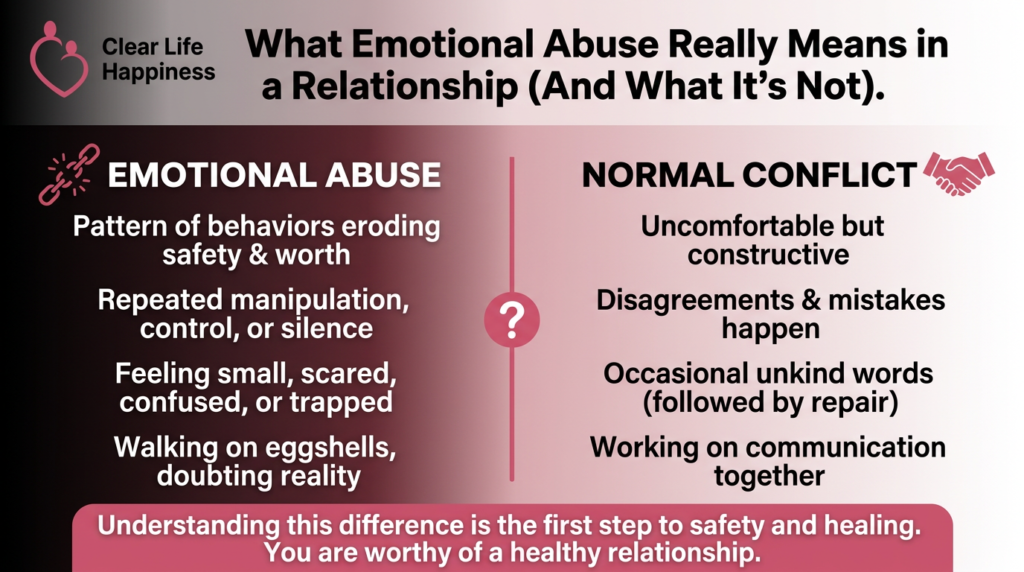
Emotional abuse means a pattern of behaviors that slowly erodes your sense of safety, worth, and reality, and couples counseling may help only when it feels safe and appropriate. It’s not just being hurt during an argument; it’s when your partner repeatedly uses words, silence, manipulation, or control to make you feel small, scared, confused, or trapped. If you find yourself constantly walking on eggshells, doubting your memory, or feeling like you’re never “good enough” no matter what you do, those are serious signs you may be facing emotional abuse—not just normal relationship conflict.
Understanding this difference matters for two big reasons. First, if what you’re experiencing is emotional abuse, giving it a name can be the first step toward safety and healing. Second, not every painful interaction is abuse. Healthy relationships still include disagreements, mistakes, and occasional unkind words. Knowing where the line is helps you react appropriately: do you work on communication skills together, or do you need to protect yourself and possibly get out?
Couples counseling and emotional abuse: what’s the actual line?
In a healthy relationship, conflict is uncomfortable but ultimately constructive. You might raise your voice sometimes, say something you regret, or shut down for a bit—but then you repair. There’s ownership, apologies, behavior change, and genuine care for how the other person feels.
You may be interested



Emotional abuse is different in three key ways:
- Pattern: It happens repeatedly over time, not just in rare, heated moments.
- Power: One partner consistently holds emotional power over the other through fear, guilt, or control.
- Purpose or effect: Whether intentional or not, the effect is that you feel smaller, less free, and less “you” in order to keep the relationship going.
You know you’re in normal conflict when:
- Both of you can bring up issues safely.
- You sometimes disagree strongly, but your basic dignity stays intact.
- Arguments lead to solutions, better understanding, or clearer boundaries.
You may be facing emotional abuse when:
- Problems only “end” if you give in, stay silent, or accept blame.
- Your partner punishes you emotionally for having needs, views, or limits.
- The relationship feels unsafe emotionally even when there’s no yelling.
Conflict challenges a relationship; emotional abuse shrinks one partner inside the relationship.
Common forms of emotional abuse (with real‑life examples)
Emotional abuse often hides inside everyday interactions, which is why many people doubt what they’re experiencing. Here are common patterns and how they might sound or look.
- Put‑downs and humiliation
- Mocking how you dress, talk, or think: “You’re so stupid; no wonder no one else can stand you.”
- Making jokes about you in front of friends, then saying you’re “too sensitive” if you’re hurt.
- Rolling their eyes or sighing dramatically whenever you share an idea or opinion.
- Chronic criticism and blaming
- Nothing you do is ever enough; they always find what’s wrong.
- You’re blamed for their feelings or actions: “I yelled because you made me.”
- When something goes wrong, they never ask, “How can we fix this?” It’s always, “This is your fault.”
- Gaslighting and reality distortion
- Denying things they clearly said or did: “That never happened. You’re making it up.”
- Making you question your memory or sanity: “You’re crazy; everyone knows how unstable you are.”
- Hiding things (like messages or money) and then accusing you of losing them.
- Isolation and control
- Getting angry or sulking when you see friends or family.
- Criticizing anyone who cares about you so you slowly distance yourself.
- Controlling your phone, passwords, money, driving, or schedule.
- Emotional withdrawal and stonewalling as punishment
- Giving you the silent treatment for days until you apologize for something minor.
- Refusing to talk about issues but still acting cold and hostile.
- Only being warm and loving again once you back down from your needs.
- Jealousy, accusations, and guilt‑tripping
- Constantly accusing you of cheating with no evidence.
- Interrogating you about who you texted or why you were “online.”
- Saying, “If you really loved me, you’d do this,” about things that cross your values or comfort.
Most emotionally abusive relationships don’t show all these patterns, but you’ll usually see several repeated over time.
Emotional abuse vs emotional cheating: how are they connected?
Emotional abuse and emotional cheating are not the same thing, but they can be related.
Emotional cheating usually means forming a secret, emotionally intimate connection with someone outside your relationship in a way that crosses agreed‑upon boundaries. It might involve flirting, sharing personal details you hide from your partner, or depending on someone else for the emotional closeness that should primarily live in your relationship.
Emotional abuse is about how you’re treated by your partner. Emotional cheating is about where your emotional energy goes.
Where they overlap:
- If you’re emotionally abused, you may become more vulnerable to emotional cheating because you’re starved for kindness, validation, and safety.
- An abusive partner may accuse you constantly of emotional affairs you’re not having, as a way to control you.
- A partner who is emotionally cheating may also become emotionally abusive—deflecting, gaslighting, or blaming you to hide what they’re doing.
In earlier articles in this series, we’ve talked about emotional cheating signs and subtle nonverbal behaviors. Emotional abuse can sit underneath those patterns, especially when you’re shamed or threatened for asking honest questions about what you sense.
Are my partner’s behaviors unhealthy, or am I “too sensitive”?
If you’re asking this, something in you already senses a problem.
You are not “too sensitive” because:
- You feel hurt when you’re insulted, mocked, or dismissed.
- You get anxious when someone you love gives you the silent treatment.
- You feel confused when your reality is constantly questioned.
These are healthy emotional alarm bells.
Here are some reflection questions that can help you sort through what’s happening:
- Do I feel more myself or less myself in this relationship over time?
- When I bring up an issue, do I feel heard—or attacked, blamed, or shut down?
- Am I more isolated from friends, family, or activities I used to love?
- Do I often minimize what’s happening when I describe it to others?
- If my friend told me this exact story, would I tell them it’s “no big deal” or that it sounds serious?
If you feel safe doing so, you might:
- Write down specific incidents with dates, words said, and how you felt. Patterns are easier to see on paper.
- Share one or two concrete examples with a trusted friend, relative, therapist, or support line.
Outside perspectives can help untangle what’s normal relational friction from what crosses the line.
Subtle signs you may be living with emotional abuse
Some emotional abuse is loud—yelling, name‑calling, obvious cruelty. Other forms are quiet and hidden, especially in relationships that look perfect from the outside.
Less obvious signs include:
- You constantly edit yourself before you speak so you don’t “set them off.”
- You apologize for everything, even when you’ve done nothing wrong.
- You feel relief when they’re not home, not because you enjoy alone time, but because you can finally relax.
- You no longer trust your feelings; you ask them or others if your reactions are “okay.”
- You feel like you’re walking on eggshells most days.
- You over‑explain ordinary decisions to avoid being criticized.
- You feel alone in the relationship, even when you’re sitting right next to each other.
If these sound familiar, your nervous system may already be trying to cope with ongoing emotional stress.
When conflict turns into control: key boundary crossings
Some turning points clearly mark a shift from hard but normal conflict into something more harmful. Watch closely when you see:
- Attacks on your core identity: insults about your intelligence, body, culture, background, or mental health.
- Threats: “If you leave me, I’ll ruin your life,” or “You’ll never see the kids again.”
- Control of resources: money, transportation, phone, immigration documents, or medical care.
- Punishment for independence: anger when you have hobbies, friends, or opinions.
- Ultimatums around safety: pressuring you to do sexual or physical things you don’t want.
These are not communication problems; they’re serious violations of respect and safety. Even if your partner occasionally apologizes or behaves lovingly, a pattern of these behaviors is abusive.
Can emotional abuse change if my partner is willing to work on it?
Change is possible in some situations—but it requires more than promises, tears, or a few flowers.
For an emotionally abusive dynamic to truly shift, you would need to see:
- Consistent acknowledgment, not minimization: “I have been emotionally abusive,” not just, “I get mad sometimes.”
- Taking responsibility without blaming you: no “I wouldn’t do this if you didn’t…”
- Long‑term behavior change, not just a few good weeks.
- Active work: individual therapy, group programs for abusive behaviors, couples counseling only when it feels safe for you.
Even if your partner is trying, your first responsibility is your own safety—emotional, physical, and financial. It’s okay to set tough boundaries or leave if the harm continues.
Remember: you cannot love, fix, or heal someone out of abusing you. Their healing is their responsibility.
What you can do if you recognize emotional abuse
If you’re starting to see your relationship in this article, you don’t have to decide everything today. You can start taking small, concrete steps.
- Validate your own experience
Quietly tell yourself: “What I’m feeling matters. It makes sense that I’m hurt and confused.” You deserve compassion—from yourself first.
- Reach out for safe support
- Talk to someone who is likely to believe you and keep your confidence.
- Consider a therapist or couples counseling only if it feels emotionally safe; if you fear retaliation for being honest, individual support is a better starting point.
- If there’s any hint of physical threats, stalking, or serious intimidation, contact a local hotline or domestic violence organization (most also support emotional abuse).
- Gather information quietly
- Learn more about emotional abuse dynamics from trusted sources.
- Keep a private record of recurring incidents if it’s safe to do so.
- Look into resources in your area: legal help, shelters, counseling, or support groups.
- Set small, clear boundaries
If you feel safe speaking up, you might say things like:
- “I will not stay in conversations where I’m being called names.”
- “If you give me the silent treatment, I’ll take that as a signal to spend my time elsewhere until you’re ready to talk respectfully.”
Pay attention to how your partner responds. Respectful partners may struggle at first but will eventually honor your boundaries. Abusive partners often escalate or try to punish you for setting them.
- Consider a longer‑term safety plan
You don’t owe anyone instant decisions. You can think through questions like:
- What would I need in place (money, housing, support) if I chose to leave?
- Who could help me practically and emotionally?
- How can I protect my privacy while figuring this out (passwords, private browsing, safe devices)?
Your safety is more important than keeping the peace.
How building emotional intelligence can protect you
Later in this series, we explore emotional intelligence in more depth, but it connects directly to emotional abuse in two important ways:
- For you: Strengthening your own emotional awareness helps you trust your feelings, name red flags earlier, and set boundaries more clearly.
- For a healthy relationship: Two emotionally intelligent partners can disagree, feel hurt, and still come back to compassion, accountability, and repair—without abuse.
Skills like naming your emotions, listening to understand—not to win—and expressing needs without attack make emotional abuse less likely to take root. They also help you recognize when a partner is unwilling or unable to meet you in that healthier space.
You deserve a relationship where honesty, respect, and care are the foundation—not something you have to beg for. For more on this topic, see related guidance.
Frequently asked questions
What is the exact meaning of emotional abuse in a relationship?
Emotional abuse is a repeated pattern of behaviors—like insults, gaslighting, threats, blame, or control—that damage your self‑worth and sense of safety. It’s not just occasional arguing; it’s when your partner routinely uses emotions and words as weapons rather than tools for connection.
Can emotional abuse happen without yelling or name‑calling?
Yes. Some of the most damaging emotional abuse is quiet: long silent treatments, subtle put‑downs, guilt‑tripping, controlling your time or money, or making you doubt your own memory. If you feel consistently afraid, small, or confused in the relationship, it can still be abuse even if no one raises their voice.
How do I know if it’s emotional abuse or just normal relationship problems?
Look for patterns, impact, and power. Normal problems lead to repair, shared responsibility, and growth over time. Emotional abuse shows up as repeated behaviors where you’re blamed, controlled, or belittled and you feel less safe, less free, and less yourself in order to keep the relationship going.
Can an emotionally abusive partner change?
Some people can change with serious self‑work, therapy, and a deep commitment to taking responsibility—not blaming you—for their actions. But real change shows in consistent behavior over time, not just apologies or promises after a blow‑up. Your safety and well‑being still come first, even if your partner says they want to change.
Is emotional abuse a reason to leave a marriage?
Yes, emotional abuse is a valid and serious reason to consider leaving, especially if it continues despite honest conversations and attempts to get help. You don’t have to stay in a relationship that repeatedly harms your mental or emotional health. If you’re unsure or feel unsafe, reach out to a trusted professional or support service to explore your options safely.