

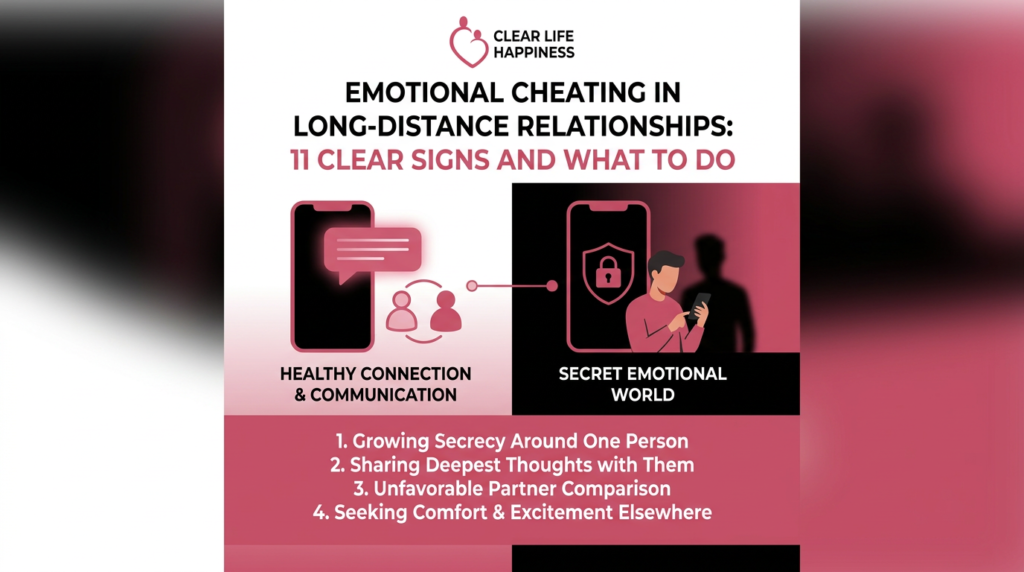
You can spot emotional cheating in a long‑distance relationship by looking for a few key shifts: growing secrecy around one specific person, sharing your deepest thoughts with them instead of your partner, comparing your partner unfavorably, and feeling a rush of excitement or comfort you “need” from that other person more than from your relationship. It isn’t just texting a friend a lot — it’s crossing the line from support into a secret emotional world that pushes your partner out.
This matters because couples counseling can help long‑distance relationships stay rooted in trust and communication, especially when emotions start to drift. When emotional intimacy quietly moves from your partner to someone else, the distance between you widens in every way — less honesty, less desire to talk, more arguments over “nothing.” The good news: you’re not helpless. You can spot early red flags, talk about them without blowing up the relationship, and, if both of you are willing, rebuild safety and closeness across any number of miles.
What actually counts as emotional cheating in long‑distance relationships?
Emotional cheating isn’t one flirty message or finding someone attractive. It’s a pattern where your emotional energy, time, and vulnerability shift from your partner to someone else — often in secret.
You may be interested



In a long‑distance relationship, emotional cheating usually includes:
- Turning to someone else first with your big feelings, worries, and wins
- Hiding or minimizing how close you’ve become to this person
- Sharing private details about your relationship that your partner would be hurt to know
- Feeling a romantic or sexual spark, even if you never act on it physically
- Defending the connection to yourself: “We’re just close friends, they understand me better”
Distance can make this feel “harmless” because there’s no physical contact. But emotionally, it can be just as painful as a physical affair. The core issue isn’t sex — it’s secrecy, emotional displacement, and broken trust.
Why long‑distance relationships are especially vulnerable
All relationships face temptation, but long‑distance couples deal with a specific mix of risk factors:
- Loneliness and time zone gaps: You might want to talk when your partner is asleep or at work, so you turn to someone who’s right there.
- Fewer everyday check‑ins: Without shared daily life, deeper conversations with someone else can feel like “filling the gap.”
- Text and social media culture: Close friendships can grow fast in DMs, games, or group chats, and boundaries blur easily.
- Idealizing your partner: When you can’t see each other often, you can start comparing them to someone near you who feels easier, lighter, or more responsive.
- Unspoken expectations: If you’ve never clearly discussed what both of you consider cheating, each person may assume different rules.
None of these make emotional cheating inevitable. But if you recognize these dynamics, you can be more intentional and gentle with each other about boundaries before something crosses the line.
11 subtle signs emotional cheating may be happening (or starting)
Not every sign means someone is emotionally cheating, but several together are worth paying attention to.
1. One person suddenly becomes “the main person” they talk to
It’s normal to have friends. It’s different when:
- Most stories involve the same person
- They go to that person with problems they used to bring to you
- They talk about that person in glowing, almost idealized ways
If your partner says things like, “They just get me so much better,” or “I can talk to them about anything,” and you feel quietly replaced, your feelings are giving you important information.
2. They hide or minimize conversations with this person
Secrecy is a major red flag. Notice if they:
- Clear chat logs or use disappearing messages
- Turn their phone face‑down or take it to another room when that person messages
- Get defensive or vague if you ask who they’re texting
You don’t need to monitor their phone to sense a shift. Your body often feels it first: a knot in your stomach when they mention that person, a sense that something important is happening off‑screen.
3. Emotional energy flows away from the relationship
Ask yourself:
- Who hears about their day first — you or this other person?
- When something big happens (good or bad), who do they contact first?
- Are your conversations getting shorter, more practical, or more surface‑level?
Emotional cheating is less about how often they talk to someone and more about how deeply and how much those talks replace intimacy with you.
4. They share your private relationship details with someone else
Venting to a trusted friend can be healthy. Emotional cheating is different:
- They complain about you in detail to this one person
- They share sexual or deeply personal information that you assumed was private
- They talk about your fights more with that person than with you
If the other person knows more about what’s going wrong between you than you do, a boundary has likely been crossed.
5. There’s a romantic or sexual charge — even if “nothing happened”
Emotional cheating often carries a low, constant spark. Signs include:
- Flirting, inside jokes, pet names
- Daydreaming about them, imagining “what if we were together?”
- Feeling jealous when they date someone else, or secretly hoping they break up
People sometimes say, “It’s just emotional; I’d never cheat physically.” But for a long‑distance partner, the emotional betrayal may hurt even more than sex.
6. They defend or protect the connection at all costs
If you gently share concern and your partner:
- Says you’re “overreacting,” “too needy,” or “controlling”
- Refuses to set any boundaries with this person
- Insists, “You just don’t like them,” instead of listening to how you feel
…they may already be emotionally invested enough to protect that relationship over yours.
7. Conversations with you feel like a chore, theirs feel like a treat
Notice how they show up:
- With you: distracted, tired, short answers, constant multitasking
- With them: animated, curious, eagerly making time, long late‑night talks
In long‑distance relationships, screens are your primary connection. When the emotional warmth moves off your calls and into someone else’s DMs, the distance between you starts to feel larger than miles.
8. Emotional intimacy with you stops growing
Healthy long‑distance couples keep learning about each other: new fears, new dreams, new parts of themselves.
Emotional cheating often freezes that growth. You might feel like you’re having the same shallow conversations while they share deeper and deeper layers of themselves with someone else.
If you sense, “You’re alive and open with them and numb with me,” your intuition is paying attention to that emotional split.
9. They rewrite the story of your relationship
You might hear new, troubling narratives:
- “We’re just so different; maybe we’re not meant to be”
- “Long distance is just too hard; maybe this is unrealistic”
- “I don’t think I can give you what you need”
Sometimes these are honest reflections. Sometimes they show your partner emotionally checking out while emotionally checking in with someone new. Watch for patterns, not isolated comments.
10. You start doubting yourself all the time
If you’re constantly asking:
- “Am I being crazy?”
- “Maybe I’m too sensitive or jealous.”
- “Maybe what they have really is just a friendship.”
…and at the same time you feel more anxious, less secure, and less connected, it’s worth honoring your discomfort instead of dismissing it.
Your feelings are not proof that someone is cheating. But they are data. In long‑distance relationships, you often have to trust your emotional radar more than physical clues.
11. They say, “You have nothing to worry about,” but won’t calm the worry
Reassurance looks like:
- Transparency (letting you into the reality of the friendship)
- Boundaries (adjusting certain behaviors to protect the relationship)
- Empathy (caring about how all this feels for you)
A red flag response is, “Trust me or don’t,” without any willingness to meet you in the middle. Healthy trust isn’t blind; it’s co‑created.
How to talk about suspected emotional cheating without blowing everything up
You don’t have to choose between silent suffering and exploding. You can start a calm, honest conversation that respects both of you.
A helpful structure is “Name, Own, Ask”:
- Name what you’ve noticed, using neutral, specific language.
- Own your feelings and needs without blaming.
- Ask for clarity and collaboration.
You can adapt these example scripts to your own voice:
- To open the conversation “There’s something I’ve been sitting with and I care too much about us to keep quiet. I’ve noticed you’ve been talking a lot with [name], and sometimes you share things with them that we don’t talk about. I feel pushed out and a bit scared about what that means for us. Can we talk about where the boundaries are and what feels okay to both of us?”
- If you feel your needs are being minimized “When I share that I’m uncomfortable, and it gets labeled as me being ‘jealous’ or ‘controlling,’ I feel dismissed. My intention isn’t to stop you from having close friends — it’s to understand where I fit in your emotional world. Can we look at this together instead of me feeling like the problem?”
- If you’re the one who may be crossing lines “I’ve realized I’ve been leaning on [name] a lot emotionally, sometimes more than I lean on you, and I haven’t been fully honest about how close that’s become. I’m sorry. You matter to me, and I want to work out boundaries that feel respectful to you and keep us safe.”
Aim for curiosity over courtroom:
- Replace “You’re clearly cheating” with “How do you see this friendship? What does it give you that you feel you’re not getting from me right now?”
- Replace “You have to stop talking to them” with “What boundaries could help both of us feel more secure?”
Healthy boundaries in couples counseling for long‑distance love without controlling it
Boundaries aren’t about policing each other. They’re about protecting the space where your relationship can breathe and feel safe.
Every couple’s boundaries are different, but common ones in long‑distance relationships include:
- Not hiding or deleting messages with close friends of the gender(s) you’re attracted to
- Letting each other know when a friendship becomes especially close or emotionally important
- Avoiding late‑night one‑on‑one calls with someone you feel attracted to
- Not sharing intimate relationship details with someone you might be drawn to
- Being open to your partner’s discomfort and adjusting behavior together
You might say:
“I don’t expect you to cut off friendships, but I do need to feel I’m still your person emotionally. Can we agree on some boundaries around private conversations and late‑night calls that keep both of us comfortable?”
Healthy boundaries will feel:
- Mutual: Both of you agree and both adapt
- Clear: You know what’s okay and what’s not
- Flexible: They can be revisited as circumstances change
If you’re unsure where your own line is, notice your body. When do you feel settled and trusting? When do you feel tense and unsafe? Your boundaries live there.
Rebuilding trust after emotional cheating in a long‑distance relationship
Emotional cheating doesn’t always mean the relationship is over. Many couples come back stronger, but it requires effort from both partners.
If you were the one who emotionally cheated:
- Take full responsibility. No “I did this because you…” Even if you were lonely or unhappy, crossing the line was your choice.
- Answer reasonable questions honestly. Your partner may need to know what was shared, how far it went, and whether it’s really over.
- Set clear boundaries with the other person. That may mean scaling back dramatically or ending the connection.
- Show consistency over time. Trust isn’t rebuilt in one grand gesture; it’s dozens of small, reliable actions.
You might say:
“I understand why you feel betrayed. I let someone else become my emotional priority, and I hid that from you. I’ve told them I need to step back, and I’m committed to earning back your trust by being transparent and present with you.”
If you were the hurt partner:
- Give yourself permission to feel everything. Anger, sadness, numbness, confusion — all are valid.
- Ask for what you need to feel safer. That could be more frequent calls, access to certain information for a period, or couples counseling.
- Decide your boundaries. What needs to change for you to stay? What would be a deal‑breaker if it doesn’t change?
- Allow time and check‑ins. You don’t have to forgive quickly. You can say, “I’m willing to try, but I need us to review how I’m feeling in a few weeks.”
Healing is not linear. Some days you’ll feel hopeful, others you may question everything. That doesn’t mean you’re failing; it means you’re human.
When emotional cheating is a symptom of deeper disconnection
Sometimes, emotional cheating exposes issues that were already there:
- Different needs for communication and closeness
- Unresolved conflicts that feel easier to avoid than address
- Lack of appreciation, affection, or emotional support
- One partner feeling like they walk on eggshells
If you decide to stay together, it helps to treat the incident as a wake‑up call, not just a one‑time mistake.
Ask each other:
- “Where have you been feeling lonely or unseen with me?”
- “What did you find in that connection that you were missing with us?”
- “What can both of us do differently so that our relationship feels more alive and emotionally safe?”
This doesn’t excuse crossing a boundary. It does make growth possible instead of getting stuck only in blame and shame.
When it may be time to step back or seek help
Sometimes the most loving thing you can do for yourself is to pause and reassess.
It may be time to step back or seek professional support when:
- Your partner denies, lies, or keeps repeating the same pattern
- They refuse any boundaries with the other person
- You’re constantly anxious, checking, and second‑guessing yourself
- You feel emotionally unsafe, belittled, or manipulated when you raise concerns
Online couples counseling or couples counseling can provide a neutral space to:
- Clarify what you’re experiencing
- Name what you need to feel respected and secure
- Decide, with support, whether to keep working on the relationship
Long‑distance love should challenge you, not slowly erase you. Your well‑being matters as much as the relationship itself.
Frequently asked questions
Is texting someone else emotional cheating in a long‑distance relationship?
Texting alone is not automatically emotional cheating. It crosses the line when the messages become secret, emotionally intimate in a way you reserve for partners, romantic or flirty, and your partner would feel betrayed if they read them. Context, secrecy, and emotional intensity matter more than the act of texting itself.
How do I know if I’m overreacting or if something is really wrong?
You’re not “overreacting” simply because you feel uneasy. Pay attention to patterns: secrecy, defensiveness, growing emotional distance, and your partner refusing to discuss boundaries are stronger signs that something’s off. When in doubt, bring it up gently and see if your partner meets you with empathy or with dismissal.
Can a relationship survive emotional cheating in long‑distance?
Yes, many couples do rebuild after emotional cheating, but it takes honesty, consistent change, and time. Both partners need to be willing: one to take responsibility and set new boundaries, the other to slowly reopen trust while honoring their own limits. If only one person is doing the work, the relationship will likely keep hurting.
Should I ask to see my partner’s messages to prove they aren’t cheating?
Wanting proof is understandable after a breach of trust, but constant checking can create a surveillance dynamic that exhausts both of you. In some situations, temporary transparency can help rebuild safety, but it should be part of a broader plan that includes open communication, clear boundaries, and ideally a path back to privacy and mutual trust.
How can we prevent emotional cheating in a long‑distance relationship?
Prevention starts with clear conversations about what both of you consider cheating, especially emotionally. Regular check‑ins, shared rituals (like nightly calls or weekly “state of us” talks), appreciation, and agreed‑upon boundaries with close friends create a sense of security. When both partners feel seen, valued, and emotionally connected, outside attachments become far less tempting.